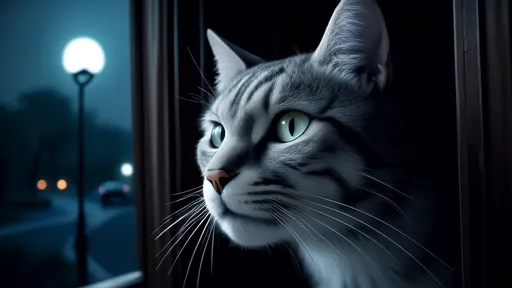
The feline ability to see in near-total darkness has long fascinated scientists and cat lovers alike. At the heart of this remarkable capability lies an ingenious biological mechanism within the rod cells of their retinas – a natural "light amplifier" that pushes the boundaries of low-light vision. Unlike human eyes that struggle in dim conditions, cats possess evolutionary adaptations that make them formidable nocturnal hunters.
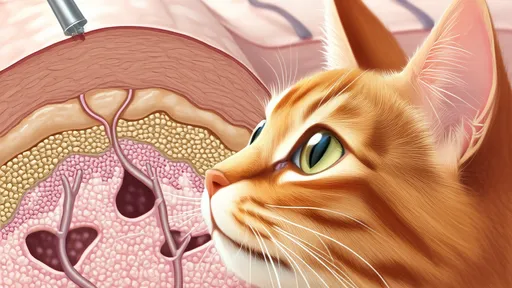
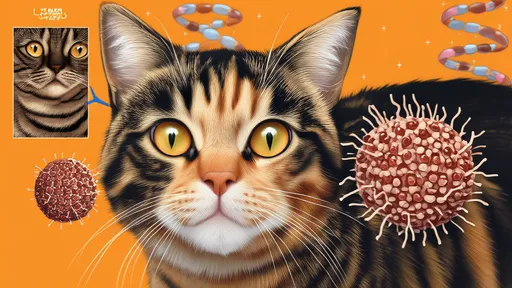
Rod cells dominate the feline retina, outnumbering human rod cells by nearly five to one. These specialized photoreceptors contain stacks of disc membranes packed with rhodopsin, the light-sensitive pigment crucial for night vision. What makes feline rods extraordinary isn't just their quantity, but their unique molecular machinery that essentially functions like biological signal boosters. When photons strike rhodopsin molecules, they trigger a biochemical cascade that amplifies the faintest light signals.
The amplification process begins when a single photon isomerizes the retinal chromophore within rhodopsin. This molecular change activates hundreds of G-protein molecules, which in turn activate phosphodiesterase enzymes. Each enzyme can hydrolyze thousands of cGMP molecules per second, causing ion channels to close and generating an electrical signal. This tremendous signal multiplication allows cats to detect light at levels about six times lower than humans require.
Evolution has optimized feline rhodopsin for superior light absorption. The protein's peak sensitivity aligns perfectly with the dim blue-green light prevalent at night (around 500 nm wavelength). Additionally, cats possess a reflective layer behind their retina called the tapetum lucidum, which bounces unabsorbed photons back through the rod cells for a second chance at detection. This dual-system approach – molecular amplification combined with physical light recycling – creates unparalleled night vision efficiency.
Recent genomic studies reveal fascinating details about the genetic basis of this system. The feline genome contains multiple copies of genes encoding critical components of the phototransduction cascade, including unusually efficient variants of transducin and phosphodiesterase. These molecular amplifiers show evolutionary signatures of strong positive selection, suggesting they were refined over millions of years of nocturnal predation.
The implications of understanding feline night vision extend beyond biological curiosity. Researchers are studying these mechanisms to develop advanced light-amplification technologies, from military night-vision equipment to low-light medical imaging systems. By reverse-engineering nature's solution, scientists hope to create devices that match the cat's ability to see clearly without generating the electronic noise that plagues conventional night-vision goggles.
Interestingly, domestic cats retain this sophisticated night vision despite living in human environments. Even well-fed house cats stalking toy mice demonstrate the same optical precision as their wild ancestors hunting in moonlit forests. This persistence of evolutionary adaptations speaks to the fundamental importance of vision in feline behavior and survival instincts.
As research continues, new discoveries emerge about the precise molecular interactions that give cats their night vision superiority. Advanced techniques like cryo-electron microscopy are revealing the atomic-level structure of feline rhodopsin and its associated proteins. These findings may one day help treat human vision disorders by providing templates for repairing damaged phototransduction pathways.
The feline visual system stands as a testament to evolution's ability to engineer extraordinary solutions to environmental challenges. From the quantum-scale interaction of single photons with rhodopsin molecules to the macroscopic reflective anatomy of the tapetum lucidum, every component works in concert to create vision capabilities that still outperform our best technological imitations. As we continue unraveling these biological mysteries, we gain not only scientific knowledge but also deeper appreciation for the sophisticated sensory world of our feline companions.
By /Jun 12, 2025
By /Jun 12, 2025
By /Jun 12, 2025
By /Jun 12, 2025
By /Jun 12, 2025
By /Jun 12, 2025
By /Jun 12, 2025
By /Jun 12, 2025

By /Jun 12, 2025
By /Jun 12, 2025

By /Jun 12, 2025

By /Jun 12, 2025

By /Jun 12, 2025

By /Jun 12, 2025

By /Jun 12, 2025
By /Jun 12, 2025
By /Jun 12, 2025